The Best CPAP Batteries for Travel and Power Outages
How to pick a CPAP battery: sizing watt-hours to your pressure, 12V vs 24V, the humidifier tradeoff, airline limits, and five picks I'd actually buy.
Disclosure: CPAP Insider is reader-supported. As an Amazon Associate and participant in other affiliate programs, we earn from qualifying purchases made through links on this page, at no extra cost to you. Learn more.
Contents
Short version
A CPAP battery is rated in watt-hours, and the single biggest thing that decides how long it lasts is whether you run a heated humidifier — that can turn two nights into two hours. Match the battery’s voltage to your machine (ResMed is 24V, most Philips and DeVilbiss machines are 12V), keep it under 100 watt-hours if you want to fly with it without asking the airline, and decide up front whether you need a pocketable dedicated battery, a heavier power station with a real AC outlet, or just a USB-C power bank you already own. None of this changes your prescription or your pressure — it only keeps the same therapy running when there’s no wall outlet.
How a CPAP battery is sized
Every battery worth buying lists a capacity in watt-hours (Wh) — volts multiplied by amp-hours. It’s the number that matters, because it’s directly comparable across brands and it’s the number airlines care about.
To turn watt-hours into nights, you need a rough idea of how much power your machine actually draws. A CPAP blowing a moderate fixed pressure with no humidification pulls somewhere in the neighborhood of 5 to 15 watts on average through the night — the exact figure depends on your pressure, your mask leak, and your breathing. So a 95Wh battery, the Medistrom Pilot-24 Lite being a common example, works out to somewhere around 6 to 15 hours: a full night for many people, two shorter nights for some, and not quite a night for anyone on a high pressure. Medistrom’s own rule of thumb for that battery is “one to two nights” at an average pressure with the humidifier and heated tube switched off, which matches what the watt-hour math predicts.
Higher pressure means more work for the blower and less runtime. A big mask leak does the same thing. If your number matters to you — a multi-night camping trip, say — the honest way to find it is to charge the battery fully, run your actual setup off it for a night at home, and see where it is in the morning.
The humidifier tradeoff
Heating water and heating the hose is where the power goes. A heated humidifier and heated tubing can pull 30 to 60 watts on their own, several times what the blower uses. Run them off a 95Wh battery and you’re looking at two or three hours, not a night.
That leaves you three practical options for battery nights: turn the humidifier off and use a waterless heat-moisture exchanger instead, run the humidifier on its lowest passive setting with no heat, or carry a much bigger battery with an AC outlet that can absorb the draw. Which one you pick depends on how much the dry air bothers you and how much weight you’re willing to haul. Switching between heated humidification at home and no humidification on the road is worth mentioning to your DME if the dryness is rough — sometimes a different mask helps — rather than changing anything about your pressure yourself.
12V or 24V: match the battery to the machine
CPAP machines run on DC power at a fixed voltage, and it isn’t the same across brands. Broadly:
- 24V: ResMed’s current and recent machines — the AirSense 10 and 11, the AirCurve line — and, with the right cable, the AirMini.
- 12V: Philips Respironics DreamStation and System One 60-series, DeVilbiss IntelliPAP I and II, and the discontinued Breas/HDM Z1 and Z2.
This is why Medistrom sells the battery in two versions — the Pilot-24 Lite and the Pilot-12 Lite — that are physically identical 95Wh units with different output voltage and different cable kits. Buying the wrong one, or the wrong machine cable, means it either won’t connect or could push the wrong voltage into the machine. Check the manufacturer’s compatibility list for your exact model before you buy, and get the cable kit made for that machine. If you’re not sure what voltage your machine is, the label on its wall power supply says so.
Portable power stations sidestep the voltage question by giving you a standard AC outlet and letting you plug in the machine’s own wall adapter — at the cost of size, weight, and some conversion loss.
Dedicated battery, power station, or power bank?
Three categories, three use cases:
- A dedicated CPAP battery (Medistrom Pilot, Zopec Explore) is tuned for this job: the right DC voltage, a cable for your machine, quiet operation, and automatic switchover if it’s sitting between the wall and the machine when the power cuts. It’s the right default for travel and for outage backup.
- A portable power station (EcoFlow, Jackery, Bluetti) is a general-purpose battery with an AC outlet. It’s heavier and it usually has a cooling fan, but it runs the humidifier, charges everything else you own, and covers a long outage. Good at home or in a car, not for flying.
- A USB-C PD power bank you may already own for your phone. With a voltage-matched trigger cable it can run some travel machines, though not a bedside unit that expects a barrel-plug DC input without an adapter. Convenient if you already carry one; not something I’d buy specifically as a CPAP battery.
Best for ResMed machines
If you use an AirSense or an AirCurve, the Medistrom Pilot-24 Lite is the straightforward choice. It’s 95Wh, so it flies in a carry-on with no airline paperwork; it’s small enough to sit on a nightstand; and left plugged in between the wall and the machine it acts as an uninterruptible supply, taking over the instant the power drops without waking you. Runtime is a night, maybe two, with the humidifier and heated tube off — a few hours if you insist on heat. The machine cable kit is a separate purchase, and you want the one for your specific model.
Medistrom Pilot-24 Lite
CPAP battery- A night or two unheated; instant switchover in an outage
- 95Wh — flies carry-on with no airline approval
- USB port and a flashlight built in
- Heated humidifier cuts runtime to a few hours
- 24V only — the wrong Medistrom (or cable) won't fit or could damage the machine
- Machine-specific cable kit is a separate purchase
Price and availability last checked 2026-09-09.
Best for Philips and other 12V machines
The Medistrom Pilot-12 Lite is the same 95Wh battery in a 12V version, covering the machines the Pilot-24 doesn’t — the Philips DreamStation and System One 60-series, the DeVilbiss IntelliPAP units, and the old Breas/HDM Z1 and Z2 travel machines. Medistrom rates it at around 16 hours at a low fixed pressure with humidification off; expect meaningfully less at higher pressure or with any heat. Everything else — the carry-on-legal capacity, the pass-through UPS behavior, the separate cable kit — is identical to the 24V version.
Medistrom Pilot-12 Lite
CPAP battery- Covers the common non-ResMed machines the Pilot-24 doesn't
- 95Wh — carry-on friendly, no airline approval
- Doubles as a pass-through UPS
- Heated humidification drains it fast
- 12V only — match it to your machine and buy the right cable kit
- Cable kit sold separately for most machines
Price and availability last checked 2026-09-09.
Best ultralight for flying
The Zopec Explore Mini is built around being small enough that you actually bring it: about a pound, roughly the size of a paperback, and near 99Wh so it stays under the airline limit. It has no cooling fan, which matters when the thing is sitting a foot from your head all night, and it recharges over USB-C in about 90 minutes. It ships with cables for the ResMed AirMini and AirSense 10/11, and it puts out DC only — so it runs the machine, not a plug-in humidifier. Figure one to two nights unheated on an AirMini, less at higher pressure.
Zopec Explore Mini
CPAP battery- Tiny and light enough that it's easy to actually pack
- Silent — no cooling fan next to your head
- ~99Wh, so it flies carry-on; fast USB-C recharge
- DC only — no AC outlet, limited humidifier support
- Runtime is one to two nights, less at high pressure
- Best with the ResMed machines it ships cables for
Price and availability last checked 2026-09-09.
Best for home outages
For keeping therapy running through a blackout — especially if you don’t want to give up your humidifier — a power station with a real AC outlet is the easier answer. The EcoFlow River 2 is 256Wh, runs the machine with humidification for roughly a night or unheated for several, and recharges to full in about an hour, so a short outage barely dents it. Its LiFePO4 cell also lasts far more charge cycles than the lithium-ion in a typical CPAP battery.
Two caveats. At 256Wh it’s over the airline limit and it weighs around 8 pounds — this is a car-and-house battery, not a travel one. And its cooling fan can be audible in a silent bedroom, the Pro model especially; if that would bother you, a purpose-built CPAP UPS battery like the full-size Zopec Explore runs silently and switches over with zero interruption, at a higher price per watt-hour.
EcoFlow River 2 (256Wh)
portable power station- AC outlet runs the humidifier a dedicated CPAP battery can't
- Recharges in ~1 hour; long LiFePO4 lifespan
- One box for the machine, phones, and a laptop in an outage
- The fan can be audible in a silent bedroom
- Over the 160Wh airline limit — car and home use, not flying
- ~8 lb
Price and availability last checked 2026-09-09.
Best if you already own a USB-C power bank
If you travel with a big USB-C PD power bank for your phone and laptop, it may also run your machine. I’ve used an Anker Prime (27,650mAh, about 99Wh) to run a travel CPAP through a voltage-matched trigger cable — one night per charge, and it still charges everything else. The limits: it won’t run a bedside machine that needs a barrel-plug DC input without an adapter, the cable has to match your machine’s voltage exactly, and the wrong voltage can damage the machine. It’s a good “already in my bag” option, not a reason to buy a power bank.
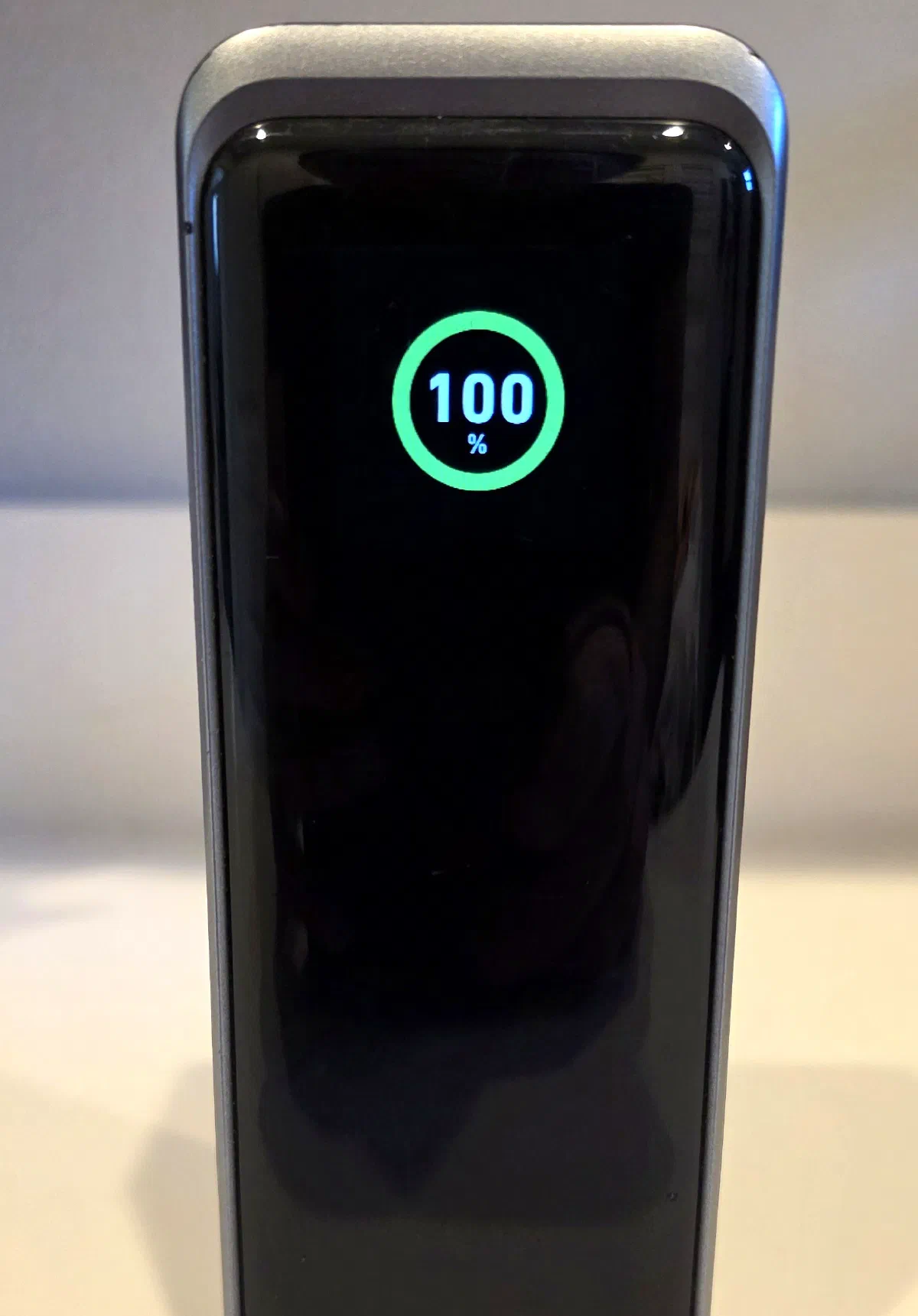
Anker Prime Power Bank (27,650mAh, 250W)
USB-C power bank- ~1 night for an AirMini at moderate pressure, no humidifier
- Recharges fast with a 100W+ charger
- Doubles as a phone/laptop bank
- USB-C PD only - many bedside CPAPs can't use it without an adapter
- Airline carry-on watt-hour limits apply (~99Wh / ~100Wh)
Price and availability last checked 2026-08-31.
Flying with a CPAP battery
CPAP machines themselves don’t count against your carry-on allowance as medical equipment, and batteries follow the standard rules for spare lithium batteries, which the FAA lays out on its PackSafe page :
- Spare batteries and power banks go in carry-on baggage only, never checked.
- Up to 100 watt-hours per battery needs no approval. 101 to 160 watt-hours is allowed with airline approval, usually a quick note at check-in, and a limit of two. Over 160 watt-hours is not allowed on a passenger aircraft at all.
- Protect the terminals from short circuits — keep the battery in its case or a bag, not loose with keys and coins.
That 100Wh line is why the Medistrom and Zopec batteries above are all in the 90-something-Wh range, and why a power station like the EcoFlow can’t come on the plane. Bring the battery’s spec sheet or a photo of its rating label; a gate agent occasionally wants to see the watt-hour number.
Pass-through and UPS use at home
Most dedicated CPAP batteries can sit permanently between the wall adapter and the machine. The wall keeps the battery topped up and powers the machine; when the power fails, the battery takes over with no gap and no alarm, and you sleep through it. If outage protection is the main reason you’re buying, this is the setup to look for — and check that the specific battery supports charging and running the machine at the same time, because not all of the cheapest ones do.
When to talk to your doctor or DME
- If your clinician has told you your therapy is medically critical — not just helpful — talk to them about a proper backup power plan rather than relying on a consumer battery you sized yourself.
- If you use supplemental oxygen with your CPAP, or a bilevel machine with a backup rate, the power math and the equipment are different; your DME should spec the battery.
- Don’t lower your pressure, turn off features, or change your machine’s settings to stretch a battery. If runtime is a real problem for how you travel, that’s a conversation with your DME about equipment — a waterless humidification option, a different machine, or a larger battery.
- If you rely on battery power often because of frequent outages where you live, your DME may be able to help you document a medical need with your utility.
This article is general information from a CPAP user, not medical advice. Pressure changes, mask choices, and therapy decisions should go through your sleep clinician or DME provider. See our medical disclaimer.