Traveling With a CPAP Machine: A Practical Overview
A hub guide to traveling with CPAP therapy: what to pack, power and humidification options, and links to flying, camping, and travel-machine details.
Disclosure: CPAP Insider is reader-supported. As an Amazon Associate and participant in other affiliate programs, we earn from qualifying purchases made through links on this page, at no extra cost to you. Learn more.
Contents
Short version
Bring your CPAP. Most people do better sticking with therapy on the road than skipping it for a few nights, since interrupted treatment can bring back snoring, daytime grogginess, and other symptoms the machine was fixing in the first place (AASM patient guide to CPAP ). Pack it in a carry-on, not checked luggage, plan for power and water before you leave, and decide ahead of time whether your full-size machine or a dedicated travel unit makes more sense for the trip. The sections below cover the basics; deeper dives on flying, camping, and travel machines are linked throughout.
Should you even bring it
For most trips longer than a night or two, yes. If you use CPAP because your sleep clinician diagnosed obstructive sleep apnea, skipping therapy while traveling means skipping it during exactly the kind of week — irregular sleep, alcohol, time zone shifts — when symptoms tend to be worse anyway. Some people who travel only occasionally decide the hassle isn’t worth it for a single weekend; that’s a conversation to have with your own clinician, not something to decide based on a blog post. If you’re on the fence, it helps to ask your sleep clinician or DME provider directly what they’d recommend for your situation.
Full-size machine vs. a travel unit
You have two basic options:
- Bring your regular machine. It’s the device your data and settings are already tuned to, and there’s no new equipment to learn. The tradeoff is size and weight — most home CPAPs are built for a nightstand, not a backpack.
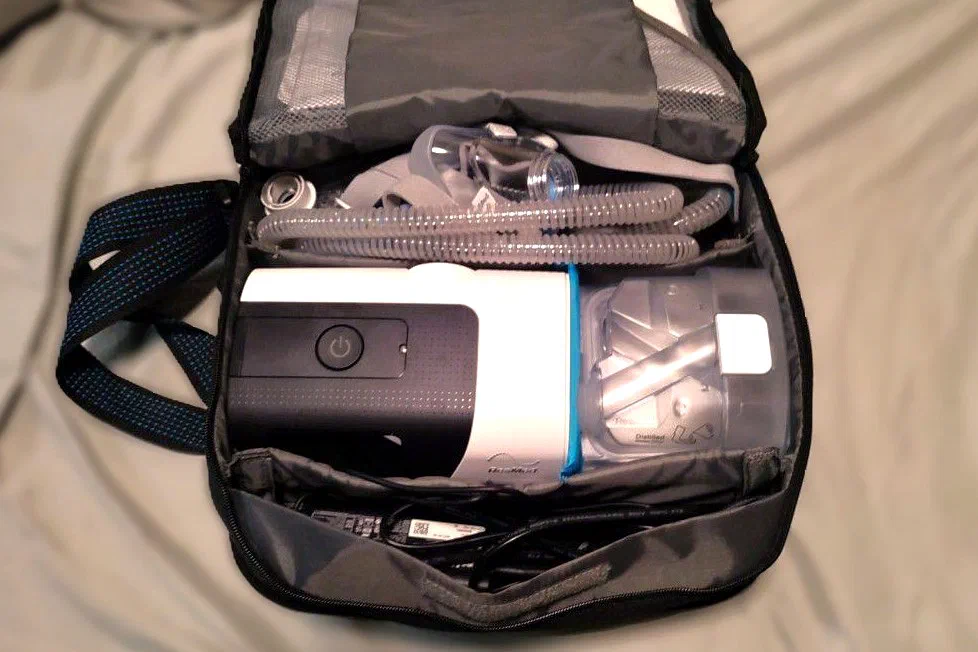
- Bring a dedicated travel machine. Units built for travel, like the ResMed AirMini AutoSet , are a fraction of the size and weight of a home machine and can run on the same pressure settings your clinician prescribed. The tradeoffs are real too: smaller water tanks or none at all, a louder sound profile on some units, and a price tag on top of the machine you already own.
If you travel a few times a year, hauling the full-size machine is usually simpler. If you travel often, or you’re dealing with things like backpacking or multi-leg flights where every ounce matters, a travel machine can be worth the investment. The tradeoffs, sizing, and specific models are a topic of their own.
ResMed AirMini AutoSet
travel APAP- Genuinely tiny and light
- Same AutoSet algorithm as the full-size machine
- AirMini-only mask setups
- No standard hose or tub humidifier
- Runs louder than a bedside machine
Price and availability last checked 2026-08-30.
Power and batteries, in brief
CPAP machines run on standard household power in most countries, but two things trip people up:
- Voltage and plugs. Most modern CPAP power supplies are dual-voltage (100–240V) and just need a plug adapter for international travel, not a bulky voltage converter — but check the label on your specific power brick before you assume this, since it varies by model.
- Power outages or off-grid nights. Camping, road trips with no outlet, or a hotel with unreliable power all raise the same question: how do you run the machine without a wall socket? Options range from CPAP-specific battery packs to general-purpose power stations, and battery life depends heavily on whether you use heated humidification (it draws much more power than the blower motor alone). Battery math and specific off-grid setups are a topic of their own.
If you’re relying on a battery for a medically necessary device, it’s worth testing it at home for a full night before you’re depending on it somewhere remote.
Humidification without distilled water
Home CPAP humidifiers are designed to run on distilled water specifically because tap and mineral water can leave mineral deposits in the tub and tubing over time (ResMed’s guidance on humidifier water ). Distilled water isn’t always available on the road — hotel rooms, campsites, and airplanes don’t exactly stock it.
A few workarounds people use:
- Bring bottled distilled water, if you’re driving or checking a bag. Bulky, but simple.
- Buy it locally. Most pharmacies and grocery stores carry distilled or “purified” water; check the label, since not all bottled water is the same as distilled.
- Skip the water tank and use an HME (heat-and-moisture exchanger). These small filters sit inline on the tubing and recycle some of the moisture in your own exhaled breath, so no water reservoir is needed at all. They don’t humidify as much as a heated humidifier, and comfort with one varies a lot by person and by climate — dry air makes them less effective. Many people find an HME is enough for a few nights of travel even if they wouldn’t want to rely on one full-time. Manufacturer instructions specify how often each HME filter should be replaced, so check the package insert rather than reusing one for weeks.
If your travel machine doesn’t include a humidifier at all, ask your DME provider whether an HME is compatible with your specific hose and mask.
Hotels, camping, and flying at a glance
Each of these deserves its own detail, but here’s the short version of how they differ:
Hotels. The easiest travel scenario — you have a wall outlet and usually a bathroom sink for rinsing your mask cushion. The main things to plan for are a distilled water source (see above) and a spot for the machine that isn’t right next to the nightstand lamp cord you’ll trip over at 2 a.m. Some travelers call ahead to ask about a CPAP-friendly room, though most hotels don’t need advance notice for this.
Camping. The bigger challenges are power (no outlet) and keeping the humidifier chamber clean without running water nearby. A battery pack sized for at least one full night, plus a plan for what happens if it runs low, matters more here than anywhere else. How to estimate battery runtime and what campers actually pack is a topic of its own.
Flying. The FAA and TSA both allow CPAP machines as medical equipment, and they don’t count against your carry-on limit (TSA guidance on medical devices ). The machine still needs to go through screening, usually removed from its case and X-rayed separately, similar to a laptop. If you’re using a travel machine with a battery, most airlines have rules about battery capacity for carry-on power banks that are worth checking before you pack one. TSA screening, gate-checking risks, and using CPAP in-flight are a topic of their own.
Carry-on, not checked luggage
This is the one habit worth repeating everywhere: your CPAP goes in the cabin with you, not in checked baggage. Airlines lose bags. A missing suitcase is an inconvenience; a missing CPAP machine is a night or more without therapy in an unfamiliar place, with no easy way to replace a prescribed device on short notice. Most airlines also don’t count a CPAP machine in its case toward your carry-on limit — it’s treated as medical equipment, similar to a wheelchair or an oxygen concentrator — but it doesn’t hurt to double check with your specific airline before you fly.
Cleaning on the road
Travel isn’t the moment to introduce a new cleaning routine, but a few adjustments help:
- Pack a small squeeze bottle of mild soap or CPAP-specific wipes instead of bringing full-size cleaning supplies.
- A quick rinse of the mask cushion in the sink at the end of the day, left to air dry overnight, covers most of what you’d do at home.
- If you’re skipping the humidifier tank for a few nights and using an HME instead, there’s less to clean overall — one less part to disinfect in an unfamiliar bathroom.
Don’t use disinfecting wipes or ozone devices on mask cushions or tubing unless the manufacturer’s instructions say they’re safe for that material; some cleaning products degrade silicone over time.
Pre-trip checklist
A short list to run through before you leave, regardless of destination:
- Machine (or travel unit) and its power supply
- Mask, spare cushion, and headgear
- Tubing, plus a spare if you have one
- Filters — pack an extra set, since these are easy to forget
- Distilled water plan, or an HME as backup
- Power adapter for international trips, or a battery pack for off-grid nights
- A copy of your prescription or a letter from your sleep clinic, in case you need to explain the equipment at security or need a replacement part while away
- Reviewing your recent CPAP data before you go, so you have a baseline for how therapy is going if travel throws off your sleep for a few nights
When to talk to your doctor or DME
A few situations are worth raising before you travel rather than figuring out on the fly:
- You’re considering a travel machine and aren’t sure it will replicate your prescribed pressure settings.
- You’re planning an extended trip (a few weeks or more) and want a backup plan if a part fails or gets lost.
- You have a medical reason you might need supplemental oxygen alongside CPAP while flying — this needs sign-off from your doctor and often advance arrangement with the airline.
- You’re switching between a full humidifier and an HME regularly and want to know whether that’s appropriate for your specific therapy needs.
None of this is about whether you’re “allowed” to travel — it’s about making sure the gear and routine you bring actually match what your therapy requires. Your sleep clinician or DME provider has seen far more travel scenarios than any single blog post can cover, and a five-minute question before a trip is a lot easier than troubleshooting from a hotel room.
This article is general information from a CPAP user, not medical advice. Pressure changes, mask choices, and therapy decisions should go through your sleep clinician or DME provider. See our medical disclaimer.